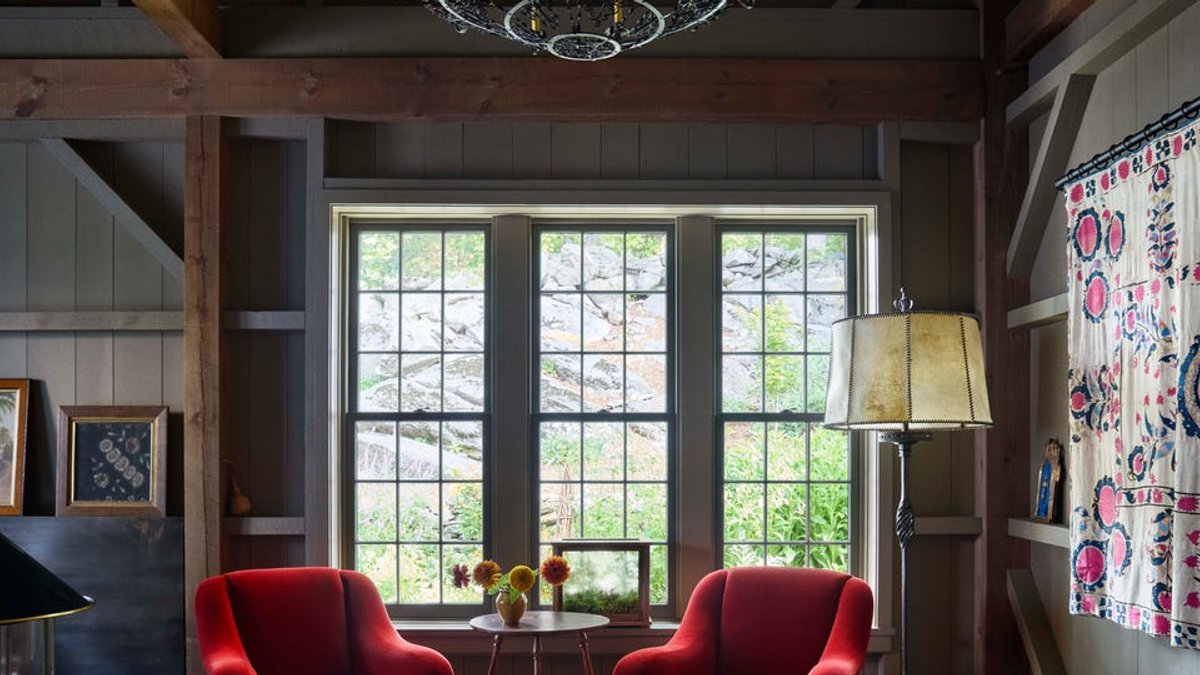
A sagging, unsupported garage beside restaurateur Rose Bonura’s 300-year-old Colonial farmhouse in Connecticut has been reimagined as a century-old barn, thanks to a three-year collaboration with designer Ryan Lawson. The transformation turned the structure into a seamless extension of the original home, blending so seamlessly that it appears to have always been part of the property rather than an addition.
The project started when Bonura asked Lawson to convert the garage into a greenhouse. Through discussions, the plan expanded into a full renovation, doubling the home’s size with a new wing that mirrors the character of the original. Lawson, founder of his firm in 2005, specializes in effortlessly combining different eras and styles. His work here drew on an 18-year friendship with Bonura, allowing him to align his choices with her preferences—such as selecting vintage stained glass for the windows to soften the light after her long shifts at her restaurant, Rosie, in New Canaan.
Bonura’s confidence in Lawson extended to bold decisions, including repainting the original house in Benjamin Moore’s Jamesboro Gold, a color initially criticized for resembling “baby poop.” After applying a single test patch, they adopted it. Inside, the design weaves together historical elements: 17th-century Venetian sconces from an Italian antiques fair were paired with custom shades, while an Ingo Maurer fixture, still bearing its original wine labels from a Los Angeles restaurant, hangs nearby. A 1980s mosaic table complements red vintage Italian chairs, and a Suzani textile functions as a sliding room divider to conceal a television.
The glass-walled walkway connecting the two structures displays ceramics and garden gourds on a bobbin étagère. Upstairs, an American needlepoint chair sits beside an Italian bed. Bonura describes the experience of living there as “walking through a museum,” where each space sparks curiosity and holds surprises.
Lawson’s ability to balance Bonura’s practical requirements, such as accommodating wintering plants, with her passion for antiques resulted in a space that feels purposeful rather than contrived. What began as a greenhouse project evolved into something far more significant: a home that tells a story through its layered design.