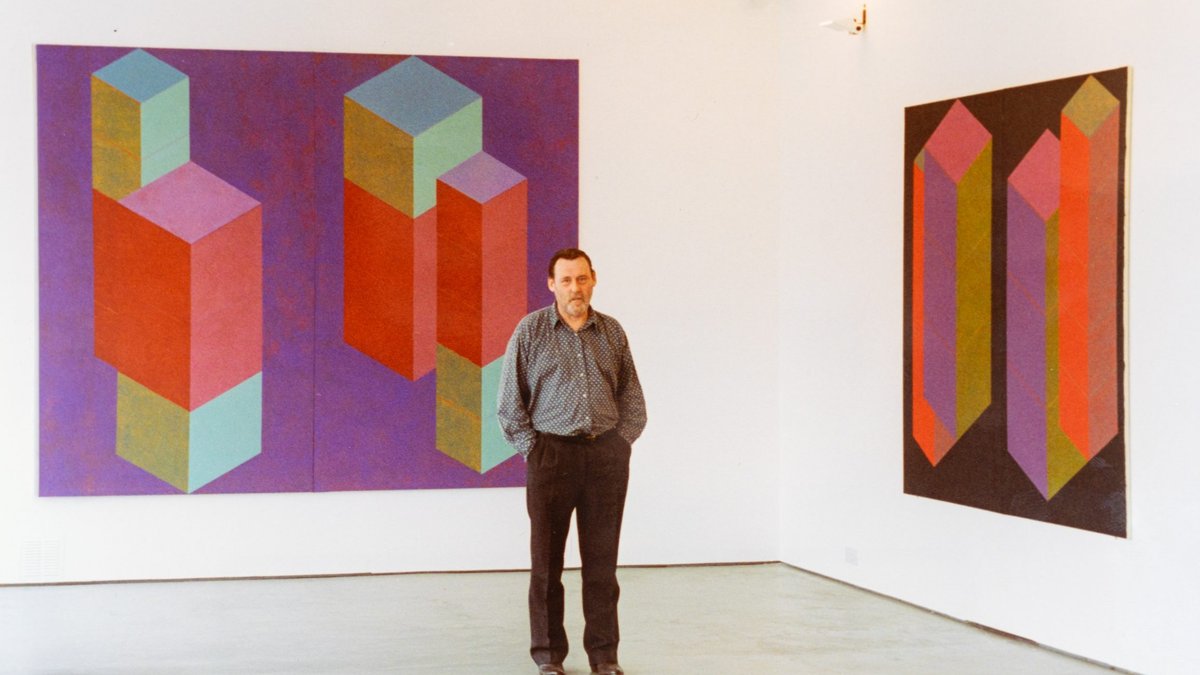
Cornwall-based abstract artist John Mitchell left behind a studio full of work when he died, and auctioneers are preparing to sell the collection in August. The two-day sale at Lay’s Auctioneers in Newlyn offers designers and collectors a rare opportunity to acquire pieces from a career that spanned five decades.
The event, scheduled for August 13 and 14, 2026, includes Mitchell’s personal collection—paintings, sculptures, and studies stored exactly as he left them. His work was largely abstract, built around mathematical systems like the Fibonacci sequence. These principles helped him create precise, geometric forms that manipulate light and space.
Work that “exists on the edge of language”
David Ross, a fellow sculptor who exhibited with Mitchell in 1994, said his art sought discovery rather than explanation. “It is the passion to find something rather than explain it, to let a set of visual conditions grow and change through the combination of the highly ordered alongside the intuited,” Ross explained.
Mitchell’s bronzes, especially his frustum pieces, interact with negative space in ways reminiscent of Ben Nicholson’s flat planes. Though minimal at first glance, the interplay of geometry and subtlety gives the work depth. These qualities make it adaptable to both modern and mid-century interiors, and auctioneers anticipate strong interest from designers.
Born in Surrey, Mitchell relocated to Cornwall and established his studio overlooking Newlyn Harbour. He trained at Kingston College of Art before launching his career with a solo exhibition at Camden Arts Centre in 1972. Over the next decade, his work appeared in major venues across Europe, including the Serpentine Gallery in London. In 1978, he received the Gregory Fellowship at Leeds University, a prestigious artist residency.
Related: Lobster art shapes Ottawa bathroom design
A career built on teaching and precision
Mitchell also dedicated himself to education. He taught at Coventry and Stourbridge Colleges of Art before leading the M.A. Fine Art program at Birmingham Polytechnic. Later, he became Senior Fellow in Fine Art at Cardiff College of Art.
His artistic process was methodical, almost scientific. Much of his work was abstract and based on proportional systems such as the Fibonacci sequence.
The sale showcases a lifetime of Mitchell’s work, uniting the worlds of mathematics and art. Lay’s Auctioneers presents the event as a way to reintroduce Mitchell’s work to new audiences. “The drama of a live auction is one of the most exciting ways to bring new art into your home,” the listing states. For designers, it provides a chance to obtain pieces that bridge art and functional decor, suitable for both contemporary and traditional spaces.
His reputation has long been stronger among artists and collectors than with the wider public. This sale may shift that. With the full contents of his studio available, his work could find new homes, admirers, and renewed attention.
A similar blend of art and design can be seen in recent collaborations that merge creative vision with practical aesthetics.