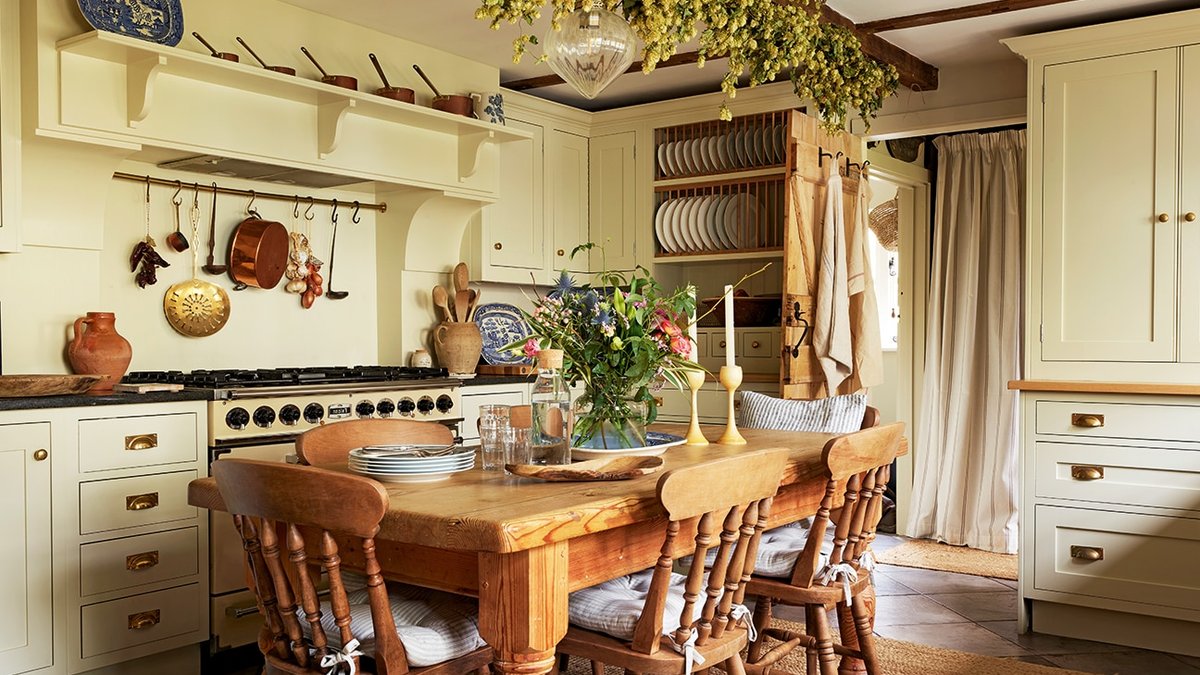
Kate Pinnock wasn’t looking for a fixer-upper when she bought her 16th-century house in Hertfordshire. She wanted a barn conversion that needed minimal work, and the property was in the wrong location. Then she walked through the front door. “I saw the big fireplace and that was it. That’s what made my mind up,” she recalls. Five years later, after a renovation that tested her patience at nearly every turn, the house has been returned to its former glory.
A Difficult Start: Leaks, Filth, and a Midnight Flit
When Kate purchased the home, it had been empty for a year. The previous tenants had left suddenly, abandoning their belongings. “It stank and it was filthy. Light switches had been pulled out, there was water coming in down the walls and when I got here the electrics weren’t working,” she says. The property needed urgent structural work, and scaffolding stayed up for six months while builders repaired brickwork, replaced tiles, and restored the windows.
Related: Celebs Who Chose Surrey Over London’s Chaos
Her career in economic development and regeneration gave her some familiarity with historic buildings. That background helped, but it didn’t make the process any easier. “It felt like one step forward, two steps back,” she says. “The most irritating thing about all of it was, you think you’ve done most of it properly and then you’ll find there’s another leak.”
The house dates back to at least 1550, when it operated as a pub. The village was a regular stop between London and Cambridge, and coaching inns lined the route. In 1965, the building became a bed-and-breakfast before being converted into a private home in the mid-1980s. Traces of that history remain. An upright beam in the long sitting room still carries a hand indentation, worn smooth by generations of patrons. “If you run your hand down it and get to a point where you can imagine leaning with a pint of beer, there is a hand indentation there,” she explains.
Related: Cornish artist’s studio sale offers design inspiration
Kate initially planned to bring bold color and pattern into the interiors, having moved from a home full of both. The house had other ideas. “I thought I could create something that’s quite rich and deep, but it’s a very dark house and I quickly realised that wasn’t going to work,” she says.
Softening the Edges With Practical Details
Hops garlands hang from beams throughout the house, a nod to Kate’s childhood in Kent, where she grew up surrounded by hop farms. They serve a purpose beyond nostalgia. Over the hearth, they cover a beam stained a “rather revolting colour” by a previous tenant. In the kitchen, they add softness to a space she didn’t design herself. “It’s lovely and really well made but I just felt it’s a little too harsh for the house, which is rough around the edges,” she explains. “I really wanted to soften it by bringing lots of wood and natural things into it.”
Related: Guilt Free Summer Cheesecake in Minutes
Her work on the refurbishment of Kelmscott Manor, William Morris’s summer home in the Cotswolds, inspired her to use Morris & Co’s Willow Boughs pattern in the bedroom. The house now feels layered and lived-in, with antique finds mixed alongside contemporary pieces. “I’ve tried to make it as cosy as possible. A little bit luxurious but like you can slob into one of the big comfy sofas and go to sleep if you want to, which is what most people do,” she laughs.