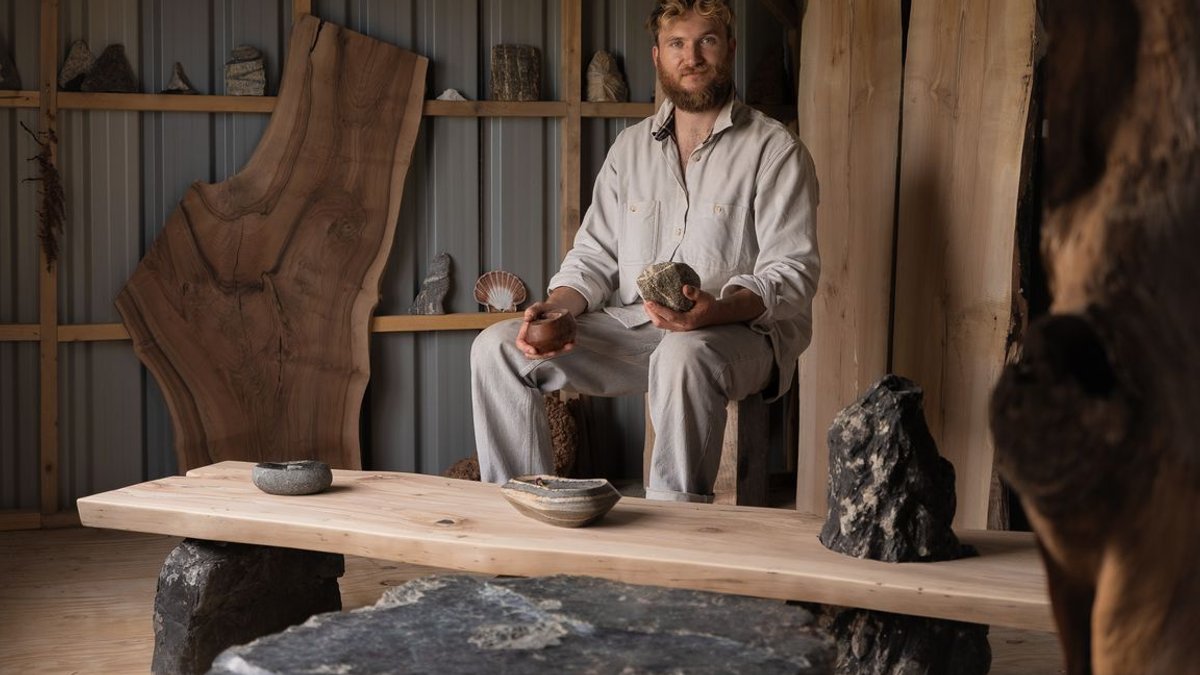
Oliver Spendley’s work is deeply connected to the Scottish wilderness that surrounds his remote studio in Sutherland. The studio, situated on Scotland’s north-west coast, offers a breathtaking view of the sea, valleys, and craggy mountains. Spendley works in a lean-to connected to his main studio building, which allows him to be partly indoors and partly outside.
He believes that being open to the elements is not only practical for his work but also influences his creative process. Spendley’s connection to nature and creativity dates back to his childhood, when he would make skate ramps from wood found in skips and fashion swords from old umbrellas.
Early Beginnings
Spendley’s career in design began with a traditional boatbuilding apprenticeship, where he learned age-old joinery skills and scribing techniques. These skills are still evident in his current creations, as is the boatbuilders’ circular way of working. After completing his apprenticeship, Spendley started a bespoke furniture workshop in the New Forest, using locally sourced timber.
However, it was his move to Scotland that marked a significant creative departure. The Highlands scenery, with its ever-changing forms, patterns, shapes, and shadows, inspired Spendley to create more expressive furniture. He was particularly drawn to the Lewisian gneiss, a type of rock found only in this part of Scotland, which is nearly three billion years old.
Related Post: Early Collaboration Key to High-Performance Building Facades
Design Process
Spendley’s design process involves pairing resonant forms step by step until a design emerges. He likens his results to the large rocks known as “erratics” found in the Highland peaks. Spendley rarely sketches his designs beforehand, instead allowing the wood to be worked away, chip by chip, to fit the contours of the rock or stone he is mirroring.
He enjoys this time-consuming yet spontaneous process, which allows him to create unique and environmentally responsible pieces. Spendley sources his wood locally from small sawmills, while the Lewisian gneiss is repurposed from ruined crofts, gathered with landowners’ consent.
Balance and Craftsmanship
Spendley believes that balance plays a central role in his practice, with both practical and sculptural elements being equally important. He loves the visual impact of something heavy, upright, and grounded, held in place not by glue but by craftsmanship and gravity. His 2026 House & Garden Craft Prize-winning work, Otherlands 04 (2025), is a stellar example of this approach.
Spendley is currently working on a new commission, creating two tables for a project in Skye in collaboration with Edinburgh gallery Bard. He is also creating another table in an ongoing series for the stores of cashmere brand Johnstons of Elgin. Spendley has faith that craft will thrive in the digital age, arguing that handmade objects will become increasingly important and anchor us to the past.